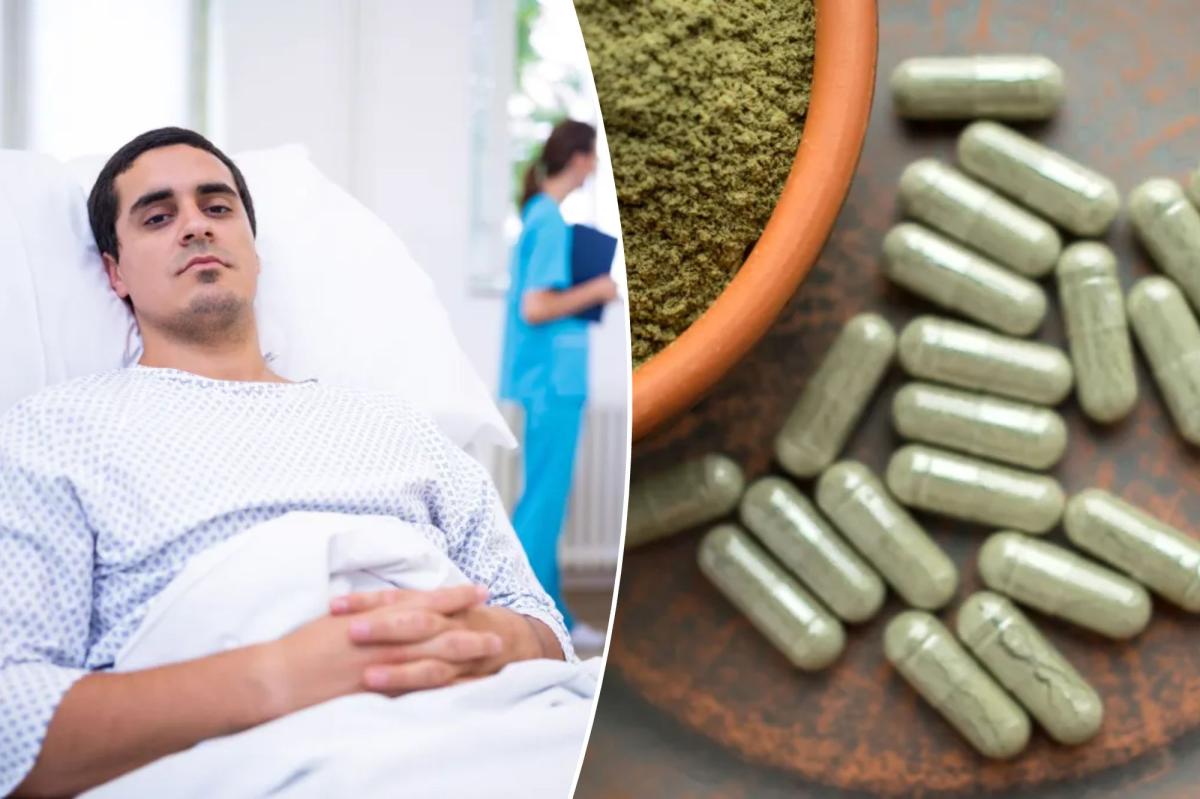
You may want to leave this medicine alone.
Calls to the nation’s poison centers about natural supplements marketed as energy boosters, mood enhancers and pain relievers have risen nearly 1,200% in the past decade, a new study has found.
Hospitalizations, and even some deaths, have been looming, with health experts sounding the alarm over a product widely available in vape shops, gas stations and online.
“The data reflect a concerning trend,” Dr. Chris Holstage, researcher and director of the University of Virginia Health System’s Blue Ridge Poison Center, said in a press release.
“This trend found in national data also occurs in our local clinical practice, with more patients presenting to UVA Health after serious complications associated with kratom products,” he added.
Kratom, an herbal substance made from the leaves of a tree native to Southeast Asia, has become increasingly popular in the United States, where it is federally legal. Supplements are generally sold as dry powders, capsules or concentrated liquids.
Kratom leaves contain two psychoactive compounds, Mitragynine and 7-hydroxymitragynine (7-OH), which bind to the same brain receptors as codeine and morphine.
Its effects vary dramatically depending on how much you take.
“Kratom in low doses has a stimulant-like effect on the brain—boosting energy, focus and mood,” Dr. Joseph Volpiselli, clinical advisor for Oar Health, previously told The Post. “As well as being sedating at higher doses, it also provides pain relief and pleasure.”
Many users turn to kratom to self-medicate chronic pain, anxiety or depression, and some even use it to manage withdrawal from opioids.
But the plant is far from harm. It is associated with a wide range of negative health effects, from mild symptoms to life-threatening complications, and can be addictive.
The risks are especially high with products that are engineered to be stronger than natural leaves, often containing synthetic 7-OH, which increases the potential for abuse and dependence.
Intrigued by the growing use and potency of kratom, UVA Health researchers analyzed poison center calls and found more than 14,400 reported exposures between 2015 and 2025.
Last year set a record with 3,434 reports, up from just 258 a decade ago.
Most cases involved men in their 20s and 30s, although reports among people aged 40 to 59 also increased, suggesting the plant is reaching a wider audience.
Hospital beds linked to kratom alone have risen even more rapidly, from 43 in 2015 to 538 in 2025—an increase of more than 1,150%.
Kratom can cause a range of side effects, including nausea, vomiting, constipation, drowsiness, dry mouth, itching, loss of appetite and muscle pain, according to the Drug Enforcement Administration.
More serious side effects have been reported with heavy or long-term use, or when kratom is mixed with other substances such as illegal drugs or antidepressants.
These include organ damage, high blood pressure, rapid heart rate, psychosis, breathing issues, seizures, muscle breakdown, substance use disorder and withdrawal symptoms.
Pollution is another concern. Kratom products are unregulated, meaning there is no guarantee of what’s inside. Some tested positive for toxic metals or harmful bacteria such as salmonella.
When used in combination with other substances, researchers found that hospitalizations increased nearly 1,300% from 40 to 549 over the decade. In 2025 alone, 60% of these multi-substance incidents led to serious medical consequences, and half of them required hospitalization.
The human toll is clear: between 2015 and 2025, at least 233 deaths were attributed to kratom, 184 of which were related to multiple substances.
“We are experiencing a significant increase in kratom-related products in the U.S. market,” Holstage said.
“We want the public to be aware that these products contain various concentrations of chemicals such as mitragynine and 7-hydroxymitragynine, which have complex pharmacological actions and can cause drug interactions and adverse outcomes in humans.”
Already in the first few months of 2026, kratom-related deaths continue.
In January, the 22-year-old daughter of former Los Angeles mayoral candidate Austin Bittner died after ingesting a mixture of prescription drugs and kratom.
“My family has experienced the incredible loss of our beloved daughter Emily,” he wrote in X. “She was a magician, the light of our lives. We are still grieving.”
Seeking to curb the dangers of kratom, Health and Human Services Secretary Robert F. Kennedy Jr. announced last year that he would push for a federal crackdown on 7-OH products.
The Food and Drug Administration wants to classify 7-OH as Schedule I — the same category as heroin and LSD — reserved for drugs with no recognized medical use and a high potential for abuse.
“7-OH is an opioid that can be more potent than morphine,” FDA Commissioner Marty McRae said in a July statement. “After the last wave of the opioid epidemic, we cannot afford to be caught flat-footed again.”
Even the American Kratom Society, a longtime advocate of the plant, advocates banning chemically modified 7-OH products.
“These 7-OH products are not kratom,” McHadoo, senior public policy fellow at the organization, said in a statement in July. “These are chemically altered substances that have strong opioid-like effects and pose a major threat to consumers.”
#Doctors #warn #increase #hospitalizations #natural #supplement