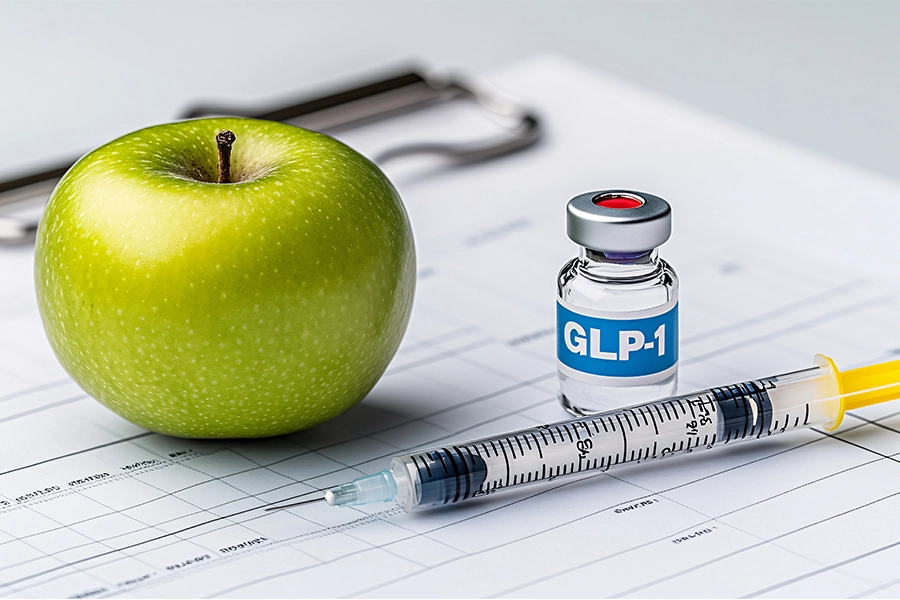
Economists at ING have published a new report on the potential impact that appetite suppressant-weight-loss drugs will have on European food demand. Insights reveal how many GLP-1 drugs will impact and reshape the industry in the coming years.
GLP-1 drugs are widely discussed as a potential change to food consumption, but their near-term impact in 2026 is minimal, says ING. Although users typically reduce calorie consumption by 15-20%, the low take-up rates (around 2% of European adults and 12% of Americans) mean that total food demand is reduced by only 0.25%, which the bank suggests is still not a major concern for F&B companies.
GLP-1 use is increasing, but at a low rate, so it is unlikely to have a significant impact on food demand in 2026-2027. However, some categories (snacks, candy, chocolate, and alcohol) are more vulnerable and should not be neglected in the short term.
GLP-1 affects food producers
According to ING, the global market for GLP-1s will reach $100 billion by 2027. The use of GLP-1 is already leading to significant changes in the way F&B is developed and marketed.
Some brands are experimenting with smaller portions, snack-sized meals, and portion-controlled packaging, while consciously packing in nutrition. GLP-1 is already driving increased demand for fiber-rich options. At the same time, there is also an increase in the innovation of protein-enriched functional drinks, which deliberately target GLP-1 users.
For food manufacturers and restaurateurs, the focus is now on delivering taste, texture and nutrition in smaller portions.
Despite reducing individual caloric intake, GLP-1 drugs have minimal impact on food demand in 2026, making it a limited concern for the F&B industry.
The ING Report: Key Points
In addition to the expected increase in GLP-1 adoption, ING expects the global market to grow 20% over the next two years, driven by increased competition, lower prices, and expanded government coverage.
There is a limited current impact, but categories such as snacks, confectionery, and alcohol are already feeling the pressure.
ING has presented four scenarios for 2030. In the most conservative estimate, adoption of GLP-1 could reduce total calorie intake in Europe by 2.5-3.5% in 2030.
Accurately quantifying how many people are using injectable drugs like Ozempic, Mounjaro, and Wegovy, either as part of type 2 diabetes treatment or as a weight loss aid to prove results, is nearly impossible at this point, as many people use personal prescriptions.
GLP-1: transformative or exaggerated?
ING raises a legitimate question in its report: Are the effects of GLP-1 on food production exaggerated?
Thijs Geijer, senior sector economist for food and agriculture at ING, says First the food ingredients That it is “still early days”. ING’s estimate of a 0.25% reduction in caloric demand indicates that the effect of GLP-1 use on food production is still very small.
“To be materially significant, the use of GLP-1s needs to continue its rapid growth trajectory. Such growth depends on lower prices, successful introduction of more drugs (including pills) and broader coverage for more patients,” he says.
“Companies report that they are seeing many changes among consumers, including a preference for smaller portions, higher nutrient density, and lower sugar products. Obviously, these trends are already there, but GLP-1s are reinforcing them.”
Changes in food costs
The ING report also cites research from another report – “The Hunger Games: How GLP-1 drug adoption is changing consumer food preferences” – which examines how consumers change their food purchases after choosing appetite-suppressing GLP-1s.
It documents the prevalence, motivation, and demographic patterns of GLP-1 adoption, and shows that US households with at least one GLP-1 user reduce rent costs by 5.3% within six months of adoption, and higher-income households reduce costs by 8.2%.
Key points include a 10% reduction in consumption of chips and savory snacks, a 5% reduction in sweet bakery, cheese and meat, and a reduction of up to 2.5% in alcohol. Meanwhile, it indicates a 0–2.5% increase in fresh fruits and vegetables.
 The increased use of GLP-1 is causing consumers to change some of their purchasing decisions and reduce their grocery spending. This is particularly evident in interesting categories such as confectionery and snacks.
F&B companies have time to adapt to GLP-1s
The ING report highlights another key point: Companies have time to prepare for the increased adoption of GLP-1s, as the industry closely monitors their impact on food choices and consumer preferences in the coming years.
PepsiCo, Mondelēz, Hershey, and Danone have all highlighted in recent earnings calls that innovation is an important part of their GLP-1 compliance strategy. Meanwhile, Nestlé is targeting GLP-1 users with a protein-rich vital tracking product line.
Product innovation and optimization are two aspects that ING offers food manufacturers and brands to think about how they will respond to a scenario where there will be a significant increase in the adoption of GLP1.
Another recommendation is for companies to consider future marketing strategies that focus on consumers who do not use GLP-1s (which is the majority of the population in any scenario), while considering how to re-engage with consumers once they withdraw from GLP-1s. As ING points out, “However, the temptations are still there, making it difficult for consumers to sustain any changes in lifestyle and consumption habits.”
A study earlier this year from Oxford University’s Nuffield Department of Primary Care Health Sciences found that people regained weight more quickly after stopping weight-loss drugs.
Oral use of GLP-1
Key food players are certainly relying on marketing products that appeal to this growing group of consumers, even if the current number of GLP-1 receptors is in its infancy.
Oral forms begin commercialization for weight loss with the first oral GLP-1 (pill version of semaglutide, the same drug as Vigovi/Ozempic) approved in late 2025 and launched in early 2026.
“Many users are curious about whether GLP-1 drugs will work for them, but don’t feel the need (or the means) to continue. This shows that this is a very dynamic group, which makes it very difficult to measure how many people are actually using it now. So it’s filtering through the noise and looking for the most robust data when evaluating a specific effect on the market.”
“Only a few products and categories appear to be completely isolated (including fruits, vegetables, water, and yogurt). This may occur as consumers’ knowledge of dietary needs matures, and when the combination of drugs and dietary advice becomes more common. Public health officials will push this to increase the likelihood of sustainable lifestyle changes.”
 F&B stakeholders will be closely monitoring the GLP-1 trend, especially as pills, which are in later stages of development, are expected to influence GLP-1 usage.
GLP-1 pills to increase absorption?
Newer oral GLP-1-type drugs are in late-stage development, with orforglipron (a non-peptide GLP-1 pill) expected to be approved later this year.
Pills are seen as a convenient way to take GLP-1 drugs. “In our opinion, oral use is one of the events that will lead to continued interest in GLP-1s and high demand,” Geiger adds.
Consequently, Geijer explains that over the next 3–5 years, F&B stakeholders should closely monitor the GLP-1 trend.
“First, look at the number of current users in key markets. Second, look at public health authorities’ decisions about extended reimbursement, and third, for European-based companies, it means what happens to sales volumes in UK retail given that it is the most advanced European market in terms of GLP-1 use.”
GLP-1 adoption may be too small to move the needle right now, but not so small as to be ignored, especially for the favorite categories.
For F&B manufacturers, a gradual adaptation strategy will likely be sufficient for 2026 and 2027. Nevertheless, it is good to consider more extreme scenarios to avoid surprises a few years from now, notes ING.
#GLP1 #weight #loss #drugs #shaping #future #European #food #demand